The Golden Rule
by Norman Rockwell
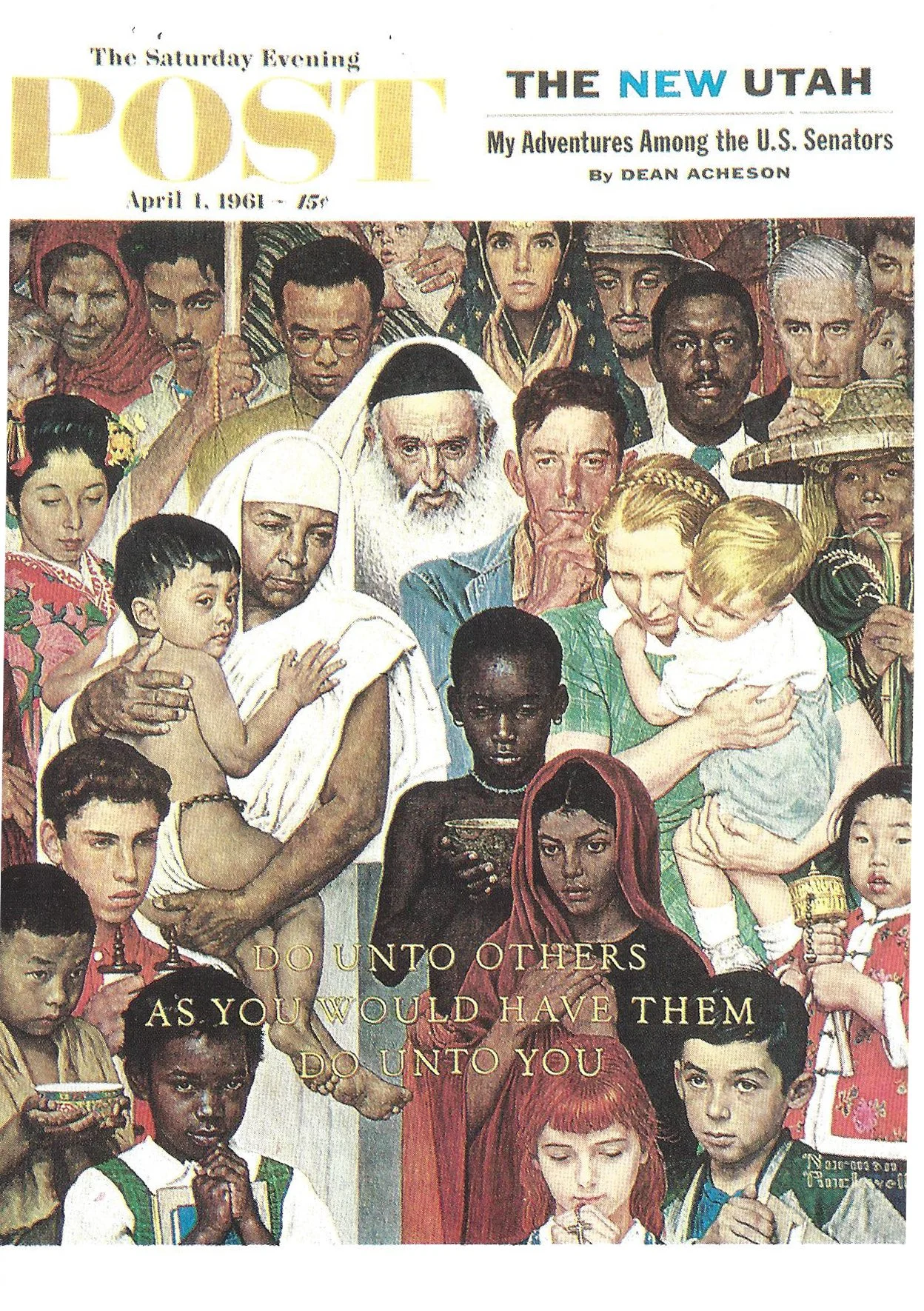
Here is the ChatGPT commentary on this very interesting and, to me, very moving, painting:
The surprising beginning: it wasn't originally The Golden Rule
In 1952, during the Cold War and the Korean War, Rockwell became deeply interested in the newly created United Nations. He conceived a huge composition called United Nations, showing representatives of the Security Council surrounded by dozens of people representing the world's peoples.
He went remarkably far with it. He researched costumes and ethnic characteristics, found models, photographed them, and made an enormous charcoal drawing—about ten feet long. But ultimately he decided the composition was simply too complicated to turn into a successful finished painting. The drawing remained unfinished in his studio for years. (Norman Rockwell Museum Audio Tour)
Then, around 1960, Rockwell had what was essentially an artistic aha! moment:
The Golden Rule.
He realized that the idea he had been struggling to express through the machinery of the United Nations could instead be expressed much more simply through the shared moral principle of treating other people as you would want to be treated. He had also been reading about comparative religion and became fascinated by how widely the Golden Rule appears across religious traditions. (Norman Rockwell Museum Audio Tour)
So he went down to the cellar, retrieved that enormous unfinished United Nations drawing, and used many of its figures as the starting point for the new painting. Some were repainted from the old work; others were newly created using people around Stockbridge as models. (The Saturday Evening Post)
That means there is a rather wonderful lineage:
1952 → United Nations drawing → 1960 idea about the Golden Rule → 1961 The Golden Rule.
The UN itself describes that connection as fundamental to the painting's history. (United Nations)
And then there is the very personal detail...
Look at the upper-right portion of the painting. The woman holding the little boy is Mary Barstow Rockwell, Norman's second wife. But Mary had died in 1959, two years before the painting appeared. And the little boy is their grandson Geoffrey, whom Mary had never met. Rockwell deliberately incorporated her into the painting in this way. (Norman Rockwell Museum Audio Tour)
I find that detail quite moving. What initially looks like a generalized, almost idealized statement about humanity contains this very private memorial to the woman Rockwell was still grieving.
And there's a wonderful Rockwell joke in the middle
The rabbi near the center is actually modeled by the retired postmaster of Stockbridge—who was himself a Catholic. 😄
That's very Rockwell: he wasn't attempting to create a collection of documentary portraits of actual religious representatives. He was constructing a visual representation of humanity, using people around him as actors/models. (The Saturday Evening Post)
And that distinction is worth keeping in mind when looking at Rockwell. His figures often look as though they are portraits of real people because, in a sense, they are—but they are also carefully constructed characters in a visual story.
It became much more than a magazine cover
The Golden Rule appeared on the April 1, 1961 cover of the Saturday Evening Post. The inscription reads:
“Do Unto Others As You Would Have Them Do Unto You.”
The response was extremely positive. And eventually the painting came full circle: in 1985, a large mosaic based on The Golden Rule was installed at United Nations Headquarters in New York, where it remains a particularly prominent work. It was restored and rededicated in 2014. (The Saturday Evening Post)
The UN's own description emphasizes that the mosaic represents people of different races, religions and cultures and connects the Golden Rule with the organization's ideals of human rights and tolerance. (United Nations)
So, in a sense, Rockwell's unfinished attempt to paint the United Nations in 1952 eventually became an artwork that actually hangs at the United Nations.
And I think there's another interesting thing to notice when you're looking at your print: this is not really the same kind of Rockwell as The Dugout. The Dugout is a wonderfully specific little drama—characters, situation, humor. The Golden Rule is Rockwell deliberately trying to say something serious and universal. He even acknowledged that distinction: most of the time he tried to entertain with his Post covers, but occasionally he had an “uncontrollable urge to say something serious.” (The Saturday Evening Post)
That makes The Golden Rule particularly interesting to me: it's Rockwell the storyteller trying to become, at least for a moment, a moral/philosophical painter. And the fact that the painting grew out of an abandoned attempt to depict the UN—and quietly incorporates his deceased wife—makes it considerably more layered than its deceptively simple message suggests.
Norman Rockwell Museum's audio tour of The Golden Rule is particularly good if you want to spend a few minutes with the painting while looking at your print.